The Double-Edged Sword: How Frequent Regulatory Updates Impact Drone Operators in Canada
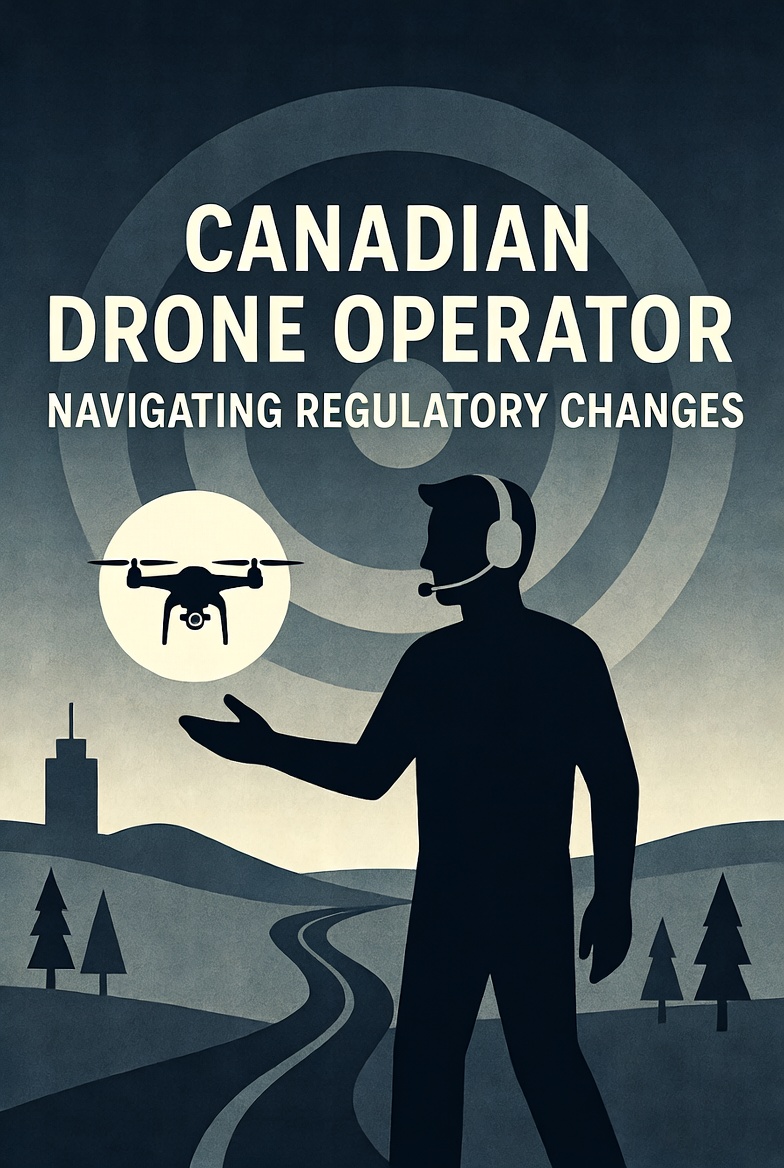
With over 115,000 registered drones and over 147,000 Pilot Certificates issued in Canada as of Nov 3/2025, Transport Canada’s November 2025 regulatory updates—including Level 1 Complex certification for BVLOS operations—represent the latest evolution in drone regulations. For operators and instructors, these frequent changes create a complex psychological reality: they simultaneously generate stress through adaptation demands while enhancing control and safety through improved frameworks. The reality for most aviation professionals is a nuanced combination of both experiences.
The Stress of Continuous Adaptation
Cognitive and Financial Pressures
Transport Canada’s 2025 framework overhaul introduced significant changes to BVLOS operations, certification requirements, and safety declarations. For the 19,707 Canadian pilots with advanced certifications, this requires comprehensive relearning of operational parameters and procedures. Training organizations face curriculum revision, instructor retraining, and student communication—creating what researchers call “continuous compliance anxiety.”
Economic stress compounds cognitive demands. New certifications mandate training, examinations, and documentation representing direct costs. Operators pursuing Level 1 Complex certification face expenses and potential operational downtime. For commercial operators dependent on continuous flight operations, regulatory changes trigger fears of income interruption—particularly acute for small operators and independent contractors lacking institutional resources.
Compliance Anxiety and Regulatory Complexity
Canadian Aviation Regulations impose fines up to CAD 3,000 for individuals and CAD 15,000 for corporations. The prospect of unintentionally operating under outdated procedures creates persistent anxiety during transition periods. With Transport Canada’s NAV Drone system managing airspace authorizations and complex controlled/uncontrolled airspace rules, operators must track multiple frameworks simultaneously—creating mental strain extending beyond flight operations into daily professional consciousness.
Enhanced Safety and Professional Control
Evidence-Based Regulatory Evolution
Transport Canada’s updates stem from Transportation Safety Board incident analysis, operational experience, and emerging technology capabilities. The November 2025 BVLOS regulations emerged from years of testing and industry collaboration, including BVLOS trials in Alberta’s oilsands. This evidence-based approach reassures operators that frameworks actively improve rather than remain static—regulations reflect lessons from actual operational challenges, not arbitrary bureaucratic decisions.
Structured Frameworks and Professional Identity
Clear frameworks reduce ambiguity-related stress. Transport Canada’s three-tier system (Basic, Advanced, Level 1 Complex) provides explicit pathways for different operational complexities. The new BVLOS framework eliminates previous case-by-case Special Flight Operations Certificate uncertainty, offering standardized requirements and predictable certification processes.
Robust regulations contribute to professional identity and industry legitimacy. The evolution from hobbyist activity to professionally regulated operations validates commercial drone expertise. Regulatory complexity distinguishes qualified professionals from casual operators, supporting business development and enhancing client confidence.
Navigating the Dual Reality
Transition Periods and Stabilization
Acute stress peaks during transitions when operators must maintain current regulations while preparing for upcoming changes. Transport Canada’s approach—announcing November 2025 updates with certification available from April but implementation deferred—creates a dual-framework mental model demanding careful attention. Once regulations stabilize and operators complete adaptation, enhanced control and safety typically dominate the psychological experience. Stress diminishes as knowledge becomes internalized.
Practical Coping Strategies
Successful operators employ strategic approaches:
- Maintain industry association and peer network connections for regulatory updates and guidance
- Schedule dedicated regulatory review time rather than last-minute preparation
- View updates as professional development opportunities, not pure compliance burdens
- Engage directly with Transport Canada’s Drone Management Portal and official guidance
These strategies reframe adaptation from reactive burden to proactive professional practice.
Conclusion
Frequent regulatory updates create neither pure burden nor pure benefit—they represent an intricate balance of adaptation stress and enhanced operational confidence. For Canada’s 115,728 registered drones operating in 2025, the regulatory framework continues evolving to address emerging technologies and safety imperatives. Success lies in developing sustainable continuous learning approaches that acknowledge adaptation challenges while recognizing improved safety frameworks’ value.
Training providers like Clarion Drone Academy play a crucial role in this landscape by helping operators navigate regulatory transitions with comprehensive, current training that transforms compliance anxiety into professional confidence. By specializing in complex operations like BVLOS and maintaining curriculum currency with Transport Canada’s evolving requirements, specialized training organizations bridge the gap between regulatory change and operator readiness—turning the stress of adaptation into competitive advantage for well-trained professionals.
As Canada’s commercial drone market grows toward six billion dollars, the regulatory framework will necessarily continue evolving. Operators who embrace continuous learning, maintain professional networks, and view regulations as safety enhancements rather than pure compliance burdens will find themselves better positioned both psychologically and professionally in Canada’s dynamic drone industry.
References
- Transport Canada. (2021). Transport Canada’s drone strategy to 2025. Retrieved from https://tc.canada.ca/en/aviation/publications/transport-canada-s-drone-strategy-2025
- Martin, M. J. (2024, March 4). RPAS in Canada: A time for reinvention. Hangar Flying. Retrieved from https://inspire.eaa.org/2024/03/04/rpas-in-canada-a-time-for-reinvention/
- Grow Trade Consulting. (2025, May 14). Canada market spotlight: Drones. Retrieved from https://growtrade.ca/2025/05/21/canada-market-spotlight-drones/
- Made in CA. (2024, November 4). Drone industry and ownership statistics in Canada for 2024. Retrieved from https://madeinca.ca/drone-industry-and-ownership-statistics-canada/
- Transport Canada. (2025, October). Transport Canada SET Branch Newsletter: Issue 3. Retrieved from https://tc.canada.ca/en/aviation/drone-safety/drone-zone/transport-canada-set-branch-newsletter-issue-3-october-2025
- Aerium Analytics. (2023, August 29). Transport Canada’s drone strategy to 2025. Retrieved from https://aeriumanalytics.com/transport-canadas-drone-strategy-to-2025/
- U.S. DOT Office of Inspector General. (2023, July 12). FAA pilot mental health: Challenges and opportunities. Retrieved from https://www.oig.dot.gov/sites/default/files/FAA Pilot Mental Health Final Report_07.12.2023.pdf
- Federal Aviation Administration. (2023). Mental health and aviation medical clearances ARC: Final report. Retrieved from https://www.faa.gov/sites/faa.gov/files/Mental_Health_ARC_Final_Report_RELEASED.pdf
- Delta Psychology. (2025, March 26). Mental health support challenges for pilots. Retrieved from https://www.deltapsychology.com/psychology-ponderings/mental-health-support-challenges-for-pilots
- Walden, T., & Thomas, D. (2024). Pilot mental health and aviation: FAA medical certification discussions. Journal of Aviation/Aerospace Education & Research. Retrieved from https://ojs.library.okstate.edu/osu/index.php/CARI/article/download/9997/8944/22799
- Hoffman, W. R. (2024, May 15). It’s time to act on pilots’ mental health. Scientific American. Retrieved from https://www.scientificamerican.com/article/its-time-to-act-on-pilots-mental-health/
- Sarsan Aviation Academy. (2024, November 28). Regulatory changes in aviation: What to expect in 2025. Retrieved from https://www.sarsanaviation.com/regulatory-changes-in-aviation-what-to-expect-in-2025/
- Scandlearn. (2025, June 20). The future is here: Aviation training challenges 2025. Retrieved from https://blog.scandlearn.com/the-future-is-here-aviation-training-challenges-2025
- FasterCapital. Aviation regulatory training: Stay ahead of the curve. Retrieved from https://www.fastercapital.com/content/Aviation-Regulatory-Training–Stay-Ahead-of-the-Curve–Latest-Updates-in-Aviation-Regulatory-Training.html
- Embry-Riddle Aeronautical University. (2023). FAA align on pilot mental health recommendations. Retrieved from https://news.erau.edu/headlines/embry-riddle-faa-align-on-confronting-pilot-mental-health-following-new-federal-recommendations