Beyond Technical Proficiency: The Leadership Crisis in Canadian Drone Operations
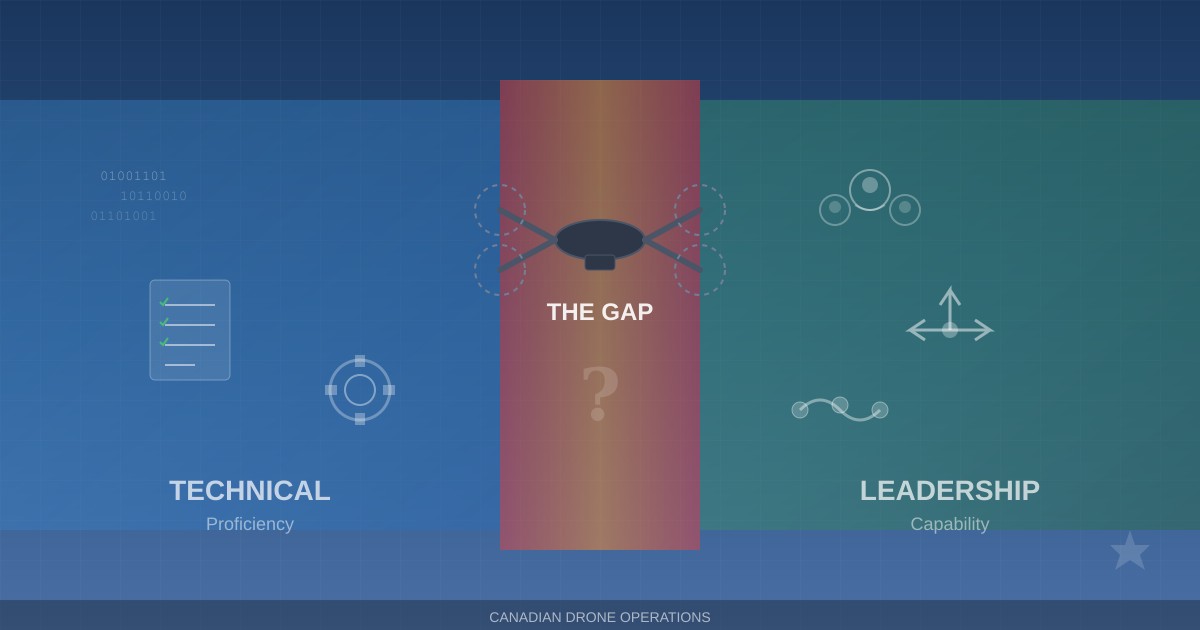
Canada’s drone market generated $4.1 billion in revenue during 2024, with projections indicating growth to nearly $10 billion by 2030. As of December 2025, Transport Canada has issued 149,026 pilot certificates across all certification levels and registered 116,304 remotely piloted aircraft systems. The November 2025 regulatory reforms permitting routine Beyond Visual Line of Sight operations represent the most significant expansion of operational capabilities in the industry’s history. Yet this technical advancement has exposed a fundamental weakness: Canadian drone operations suffer from a critical shortage of leaders capable of managing complexity, adapting to changing client requirements during active missions, and transforming sensor data into actionable business intelligence.
The Certification-Competency Disconnect
Transport Canada’s certification framework establishes three operational tiers: Basic Operations (128,888 certificates), Advanced Operations (20,138 certificates), and Level 1 Complex Operations for BVLOS operations under 150 kilograms (249 certificates). This regulatory structure produces operators who understand Canadian Aviation Regulations Part IX and emergency procedures. However, current training focuses primarily on regulatory compliance and flight mechanics, producing operators prepared for textbook scenarios rather than complex commercial realities.
When a Saskatchewan mining company requests additional coverage of an unexpected geological feature mid-mission, the situation demands rapid risk assessment, real-time flight planning modifications, regulatory compliance verification, and client expectation management—all while maintaining safety margins. Many technically proficient pilots struggle in these moments, defaulting to rigid adherence to original plans rather than demonstrating adaptive decision-making that distinguishes operational leadership from basic piloting capability.
The Data-to-Value Translation Gap
Modern remotely piloted aircraft systems generate extraordinary data volumes—single agricultural flights produce hundreds of gigabytes of multispectral imagery, while infrastructure inspections capture thousands of photographs. Yet data acquisition represents merely the initial step. The critical challenge involves converting raw information into decision-enabling intelligence. Many operators excel at data capture while struggling with business context translation. A pilot delivers pristine thermal imagery of pipeline infrastructure but fails to prioritize temperature anomalies by maintenance urgency. Survey data meets technical standards yet arrives in formats requiring substantial client-side analysis rather than ready-to-implement recommendations.
Effective leadership means understanding client business objectives beyond technical requirements. A forestry service provider doesn’t simply document tree canopy—they identify harvest-ready areas, quantify merchantable timber volumes, highlight optimal access routes, and flag environmental regulation compliance requirements. This transformation from data collector to business advisor defines the leadership capacity missing across much of the Canadian drone industry.
Crisis Management and Operational Complexity
Transportation Safety Board data reveals evolving safety challenges. Between 2014 and 2017, the TSB documented 30 near-miss incidents and eight drone-involved occurrences. The October 2017 collision between a drone and a Beechcraft A100 King Air near Quebec City demonstrated concrete consequences—the drone operated at 450 meters, substantially exceeding the 122-meter maximum, causing structural damage requiring emergency declaration. As BVLOS operations proliferate, leadership deficiencies in crisis management will generate increasingly severe consequences.
Commercial operations function within complex stakeholder environments involving Transport Canada oversight, NAV Canada coordination, property owners, and public engagement. Transport Canada’s Arctic Unmanned Aircraft System Initiative exemplifies this complexity—success requires coordinating with Indigenous communities, respecting traditional land use patterns, and building trust through transparent communication. Technical capabilities launch missions; leadership skills ensure broader objectives are achieved while maintaining essential community relationships.
Building Leadership Capacity
Addressing Canada’s leadership deficit requires systematic changes across training, professional development, and industry culture. Training programs must expand beyond regulatory compliance toward business communication, client management, and crisis decision-making. Scenario-based training simulating mid-mission scope changes and equipment failures better prepares pilots for operational complexity. Experienced operators possess invaluable practical knowledge that formal training cannot replicate. Collaborative platforms like Clarion Drone Academy’s community portal demonstrate the value of peer engagement, where operators support each other with operational questions and share project experiences.
The industry must recognize and reward leadership capabilities alongside technical proficiency through hiring practices that evaluate decision-making ability and communication effectiveness. Canadian drone operators can adapt frameworks from crewed aviation’s crew resource management, emergency response crisis communication, and project management methodologies. Borrowing these established frameworks accelerates leadership development rather than constructing entirely new systems.
Conclusion
Canada’s drone industry occupies a critical inflection point. Transport Canada’s regulatory modernization, projected market growth to $10 billion by 2030, and expanding BVLOS permissions create unprecedented opportunities. Yet realizing this potential requires operational leaders capable of managing complexity, translating technical capabilities into measurable business value, making sound decisions under pressure, and maintaining stakeholder trust. Current emphasis on technical certification produces pilots skilled at executing predefined missions—necessary but insufficient for sustainable commercial success.
Addressing this leadership deficit requires deliberate investment in training programs extending beyond regulatory compliance, mentorship systems transferring practical operational wisdom, and industry recognition mechanisms for leadership competencies. Organizations prioritizing leadership development alongside technical excellence will establish sustainable competitive advantages. The hardware systems, sensor payloads, and software platforms enabling modern operations demonstrate impressive engineering. However, sustainable competitive advantage will increasingly accrue to those combining technical proficiency with leadership capacity—the human-centered skills required to navigate operational complexity, deliver quantifiable business value, and build lasting client relationships. The industry’s primary constraint is not technological capability—it is human leadership capacity.