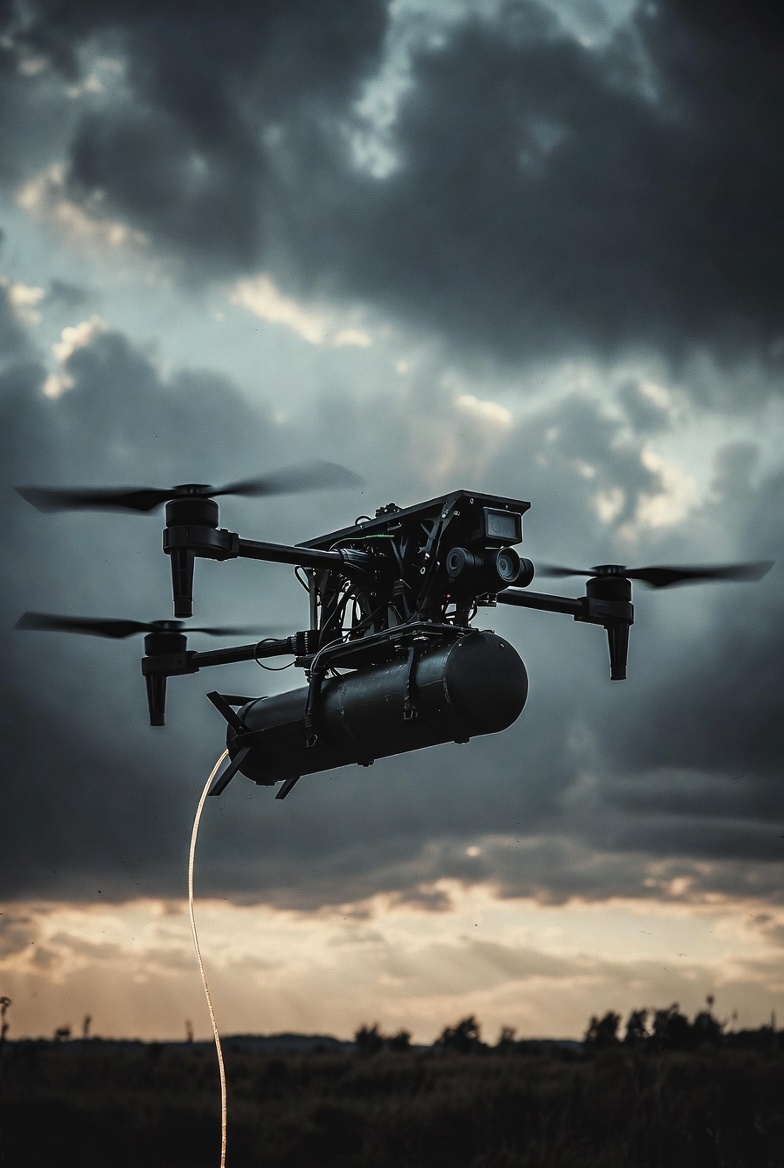
Why Fiber-Optic Drones Are Rewriting the Rules for Canadian Operators
Combat footage from eastern Europe reveals a dangerous pattern: soldiers trusting countermeasures that fundamentally misunderstand modern drone warfare. Thermal blankets glow under infrared cameras. Electronic jamming fails against fiber-optic control cables. For Canada’s $4.1 billion drone industry—with 116,304 registered drones, 149,026 certified pilots, and 368 active RPAS Operator Certificates—the lesson is clear: technology alone never wins wars. Training does.
The Fiber-Optic Revolution Redefining Combat
The Russia-Ukraine conflict has fundamentally transformed how militaries worldwide think about unmanned systems. By mid-2024, both sides deployed fiber-optic controlled First Person View drones that changed battlefield dominance. These systems maintain control through gossamer-thin fiber-optic cable extending up to 20 kilometers, immune to conventional countermeasures. While electronic warfare systems successfully jam 75-90% of radio-controlled drones, fiber-optic variants operate undetected and unjammable, transmitting high-resolution thermal and optical video without radio signals. By April 2025, Ukraine’s Ministry of Defense had certified nearly 40 fiber-optic drone models. The implications extend globally: Mali’s Azawad Liberation Front and Myanmar’s Kachin Independence Army deployed similar technology, prompting NATO Allied Command Transformation to launch its 16th Innovation Challenge in June 2025, specifically focused on countering this threat.
The Thermal Detection Fallacy
Perhaps no misconception proves more dangerous than believing thermal blankets provide effective concealment from modern drone systems. Combat footage repeatedly demonstrates operators detecting personnel hiding under thermal covers through advanced cameras integrated into reconnaissance and strike platforms. The physics are straightforward: heat signatures transform rather than vanish. A human body emits approximately 100 watts of thermal energy. Thermal mitigation materials create barriers but redistribute heat across different patterns. Modern sensors, particularly those paired with AI-driven detection algorithms, easily distinguish ambient variations from masked human sources.
Ukrainian forces equipped drones with interchangeable video systems featuring daylight, low-light, and thermal cameras, enabling accurate target identification regardless of conditions or attempted concealment. Drones account for approximately 70% of battlefield losses for both sides, with thermal-equipped systems proving particularly effective during night operations. For Canadian operators, the lesson is clear: understanding sensor capabilities matters more than purchasing countermeasures advertised as solutions.
The Training Imperative for Canadian Operators
Transport Canada’s November 4, 2025 regulatory changes introduced Level 1 Complex Operations certification for BVLOS operations. In just over a month, 249 pilots obtained this credential while 368 RPAS Operator Certificates were issued. However, technical proficiency with Canadian Aviation Regulations represents only the foundation. Ukraine’s experience shows successful drone operations require integrating unmanned systems into comprehensive Tactics, Techniques, and Procedures—not treating them as standalone capabilities.
Clarion Drone Academy has positioned itself at this critical intersection. Since 2014, the company has specialized in training government, military, and corporate clients on advanced operations that go beyond regulatory compliance. Clarion’s approach emphasizes operational integration over checkbox certification—understanding sensor physics, electromagnetic spectrum considerations, and tactical employment rather than merely meeting minimum requirements. As Canada’s commercial drone market reaches toward $5.1 billion by 2030, the distinction between basic certification and operational competence creates market differentiation. Operators investing in comprehensive training command premium positioning. Those relying solely on regulatory minimums compete on price in commoditized markets.
Technology Integration Versus Technology Procurement
The Ukraine conflict reveals a critical distinction: technology advantage proves temporary, but integration advantage compounds. Both sides rapidly adopted fiber-optic drones, thermal systems, and AI-assisted targeting—the side that integrated these into comprehensive operational frameworks gained lasting advantages. Canadian operators face similar choices. DJI dominates nearly three-quarters of Canada’s drone market, providing widespread access to capable hardware like the Matrice 350 RTK with H30T thermal camera. Hardware accessibility means competitive advantage no longer comes from equipment alone, but from understanding how to employ it effectively—knowing when thermal imaging reveals more than optical sensors, understanding electromagnetic spectrum considerations, and recognizing how weather and terrain affect sensor performance. For government and military clients, procurement processes often focus on technical specifications while operational effectiveness depends on employment methodology.
Building Canada’s Operational Expertise
Canada’s drone industry stands at an inflection point. Transport Canada’s progressive regulatory framework, supported by 269 drone flight schools (including 68 Level 1 Complex Training Providers) and 1,328 Flight Reviewers, enables sophisticated operations. Market projections suggest sustained demand across agriculture, mining, infrastructure, and public safety. However, regulatory permission doesn’t automatically translate to operational competence. The path forward requires moving beyond minimum compliance toward comprehensive operational education. For military applications, this imperative grows stronger—Canada’s Department of National Defence announced in July 2025 its exploration of uncrewed combat drones to complement the F-35 fleet. As military applications expand, the gap between procurement and operational reality could prove costly. Ukraine demonstrates daily that technology without understanding creates false confidence, not capability. Canadian operators can learn these lessons through observation rather than experience.
Conclusion: From Compliance to Competence
The fundamental lesson emerging from modern drone warfare is uncomfortably simple: technology adoption without operational understanding creates vulnerability, not capability. Sophisticated hardware deployed by operators who don’t comprehend sensor physics, electromagnetic spectrum effects, or tactical integration performs worse than basic equipment in skilled hands. For Canada’s growing drone industry, this represents both warning and opportunity. The regulatory framework enables advanced operations. Market growth creates demand. Hardware accessibility provides capable tools. What remains scarce is the operational expertise that transforms regulatory permission and technical capability into effective performance.
Operators who invest in comprehensive training—understanding sensor physics, electromagnetic considerations, tactical employment, and mission integration—will separate themselves from competitors who treat drone operations as checkbox compliance exercises. In an industry projected to reach $10 billion by 2030, the premium increasingly flows to competence, not just certification. The battlefields of Ukraine write the syllabus. Canadian operators would be wise to study it carefully.