Canada’s Arctic Sovereignty at Risk: The Drone Technology Gap
Canada faces a critical national security challenge as adversaries rapidly outpace NATO in Arctic-capable drone technology. A December 2024 Center for European Policy Analysis report reveals Russia and China are exploiting surveillance gaps across Canada’s northern territories while Canadian procurement remains fragmented and slow. With the Arctic representing 40 percent of Canada’s land mass and climate change opening trade routes, the timing is urgent. As Transport Canada has certified over 107,000 drone pilots and the industry prepares to grow fivefold to $15.5 billion by 2035, Canada’s inability to deploy Arctic surveillance drones represents a profound sovereignty vulnerability.
The Strategic Reality: NATO Falling Behind
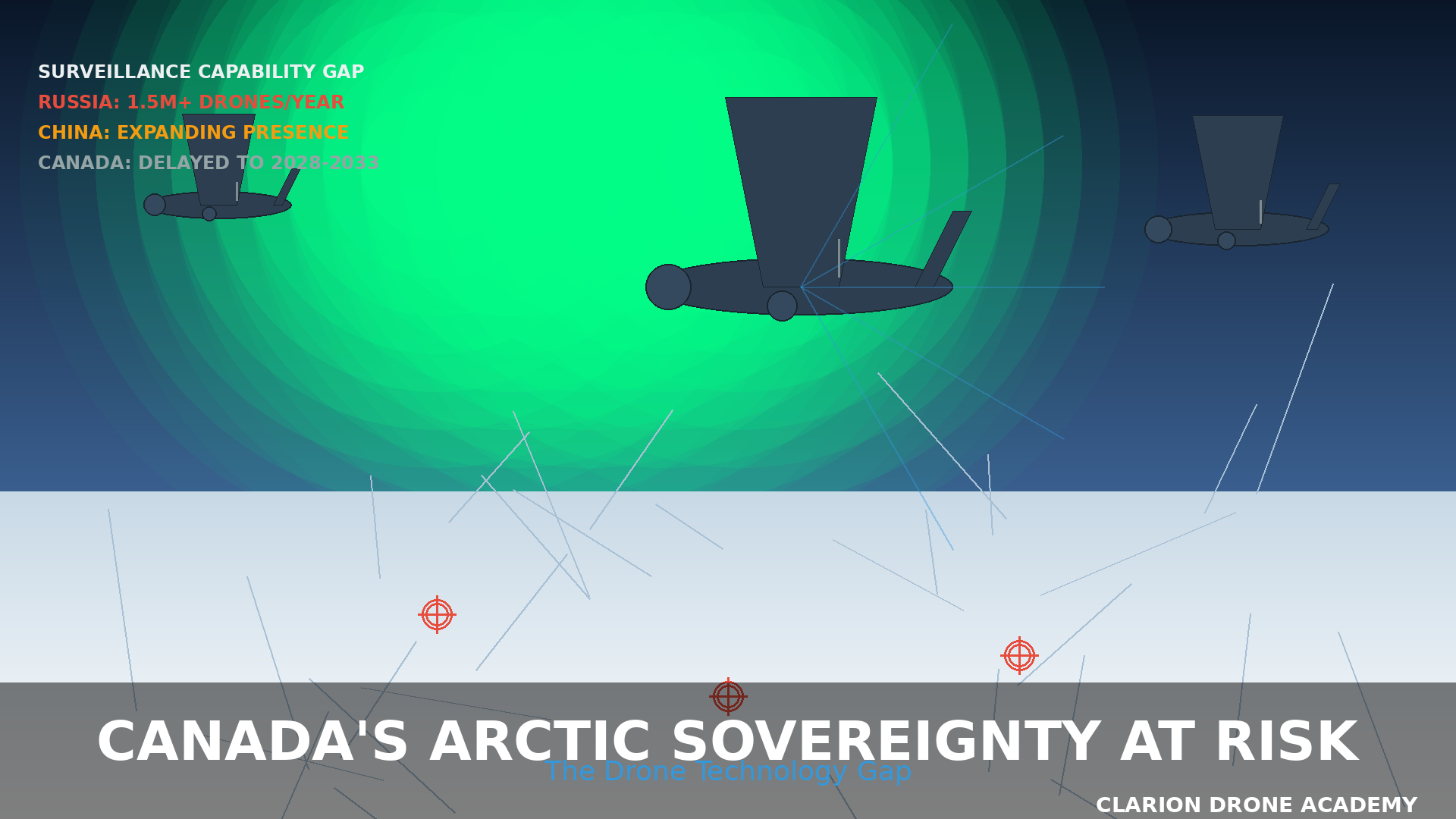
The CEPA report delivers an unambiguous assessment: procurement of Arctic-capable drones across NATO remains fragmented, slow, and risk-averse. Most allies prioritize temperate-climate systems and later attempt Arctic adaptation, resulting in few NATO-certified Arctic-ready platforms. Russia and China are investing heavily in uncrewed capabilities, strengthening their Arctic presence while exploiting surveillance gaps. Russia’s annual drone production exceeds 1.5 million units, supported by China and Iran, with Norwegian intelligence expecting numbers to grow by an order of magnitude. The Russian Navy established a drone control center in Kamchatka for maritime patrols and anti-submarine warfare along the Northern Sea Route.
Canada currently has no Arctic-capable drones. The Royal Canadian Air Force is acquiring 11 MQ-9B Reapers from General Atomics for $2.5 billion, but deliveries won’t begin until 2028 with full operation by 2033. Originally scheduled for 2024, delivery was pushed back for Arctic modifications and winter testing. Transport Canada’s $36 million Hermes 900 Starliner remains undeployed as aviation services merge with Defence, driven more by NATO spending targets than operational strategy.
Combat-Proven Adversary Advantages
Ukraine war innovations have accelerated Russian drone warfare capabilities NATO forces lack. The battlespace teems with countermeasures at all ranges and frequencies, creating a combat laboratory for institutional learning. Russia is training thousands of drone operators, creating dedicated uncrewed system branches with specialized units including UAV naval regiments. China has prioritized remote-sensing, polar-shipping technology, and communication networks in the Arctic. DJI generates three-quarters of Canadian drone market revenue, providing technological expertise while raising supply chain security concerns. General Wayne Eyre warned in 2022 that Canada’s Arctic territorial hold is tenuous, facing challenges from both Russia and China, with Ukraine potentially weakening Russia into a Chinese vassal state.
Arctic Operational Demands
Multiple gaps exist between NATO drone inventories and Arctic operational demands. Few vehicles are winterized for persistent use in extreme conditions. Cold-rated batteries, thermal-management systems, and prepositioning spare parts are essential for high sortie rates in extreme weather. Queen’s University researchers are developing floating charging platforms and efficient control algorithms, but acknowledge a significant gap between simulation and actual Arctic conditions. The military drone market will grow from $16 billion USD in 2024 to $47 billion by 2032, yet Canada’s procurement timeline leaves the country vulnerable throughout this critical period.
Critical Infrastructure and Timeline Gaps
NORAD’s aging radar networks require two decades to modernize, leaving Arctic approaches vulnerable during unprecedented competition. Canada allocated $6.69 billion over 20 years for surveillance modernization and $15.6 billion for NORAD infrastructure including four northern upgrades. March 2025 saw $420 million for Arctic operations including new drones and seafloor sensors. A new Arctic satellite ground station will improve threat detection and ally communication. However, twenty-year timelines offer little comfort when adversaries deploy capabilities today. Russia’s 1.5 million annual production and China’s expanding presence create immediate vulnerabilities. The disconnect between threat evolution and procurement represents a strategic mismatch adversaries will exploit.
Underutilized Domestic Capabilities
Canada’s commercial sector demonstrates significant untapped potential. Over 97,000 registered drones and 100,000 certified pilots support nearly 200 startups. Transport Canada’s April 2025 BVLOS regulations allow routine operations without Special Flight Operations Certificates for drones up to 150 kg in uncontrolled airspace over sparsely populated areas—precisely Arctic conditions. A Fraser Lake pilot program performed 1,200 flights including medicine deliveries to Stellat’en First Nation, demonstrating technology’s promise for remote access gaps. Similar capabilities could provide persistent Arctic surveillance, environmental monitoring, and sovereignty assertion if adapted for extreme weather and integrated with military systems.
Small enterprises face resource challenges for R&D, validation, and scaling. International competition, particularly DJI’s market dominance, impedes domestic manufacturers. Transitioning from commercial to military-grade Arctic systems requires substantial investment in hardening, winterization, secure communications, and defense network integration—resources startups cannot access without government partnership and procurement commitments. Finland and Sweden’s NATO accession offers opportunities to coordinate northern defense, but NATO lacks a formal Arctic strategy, risking diluted resourcing and cooperation.
Urgent Action Required
Arctic sovereignty faces a technology gap adversaries actively exploit. Russia’s combat-tested experience and Arctic-specific development represent advantages Canada cannot match on current trajectories. November 2025 Transport Canada regulations introducing Level 1 Complex Operations provide a framework for rapid deployment if resources follow. Canada must accelerate Reaper acquisition, immediately deploy the Hermes 900 under clear command, invest in domestic Arctic-capable development, establish northern support hubs with equipment prepositioning, and integrate with NATO allies to create coordinated northern defense.
Climate change ensures Arctic routes will continue opening, increasing strategic competition. Well-trained operators with advanced technology possess competitive advantages in both commercial markets and sovereignty assertion. Canada’s 40 percent Arctic land mass represents not merely geography but a national security imperative demanding investment proportional to the threat. Surveillance gaps adversaries exploit will only widen unless Canada acts decisively to close the drone technology gap and assert effective control over northern territories.