Discipline Beats Complacency: The Competitive Edge in Canadian Drone Operations
Experienced pilots often become their own worst enemies. Success breeds assumptions, repetition creates shortcuts, and routine operations invite reduced vigilance. Aviation human factors research identifies this pattern as complacency—one of the most common preconditions for accidents and incidents. With 116,304 registered aircraft, 149,026 certified pilots (128,888 Basic and 20,138 Advanced), and market valuations reaching USD $4.1 billion in 2024 (projected to exceed USD $10 billion by 2030), Canada’s commercial drone industry faces a critical inflection point. Transport Canada’s November 2025 regulatory implementation opening routine BVLOS operations creates unprecedented opportunity for operators with systematic, documentation-driven frameworks, while those relying on informal procedures face compliance challenges and competitive disadvantages.
Human Factors Research and Regulatory Consequences
Gordon Dupont, developing training programs for Transport Canada in 1993, characterized complacency as diminished hazard awareness during habitually repeated activities—one of twelve critical human factor preconditions contributing to aviation accidents and incidents. Individuals conducting familiar tasks develop false confidence, leading to procedural omissions, memory-based operations rather than checklist-verified actions, and expectancy errors where operators perceive anticipated conditions rather than actual circumstances. This manifests distinctively in RPAS operations: commercial operators bypass pre-flight verifications after dozens of successful missions, pilots make airspace authorization assumptions based on previous approvals, and crews reduce operational briefings at familiar sites.
November 2025 Regulations and Market Transformation
The November 4, 2025 regulatory implementation establishes Level 1 Complex Operations certification enabling routine BVLOS flights for aircraft up to 150 kilograms in uncontrolled airspace below 122 meters, eliminating case-by-case SFOC applications that previously created substantial operational constraints. However, certification requires 20 hours of ground school, advanced operations examination, and practical flight review. Organizations conducting complex operations must obtain RPAS Operator Certificates demonstrating systematic safety management, documented procedures, maintenance programs, training curricula, and emergency response protocols.
As of December 17, 2025—just six weeks after implementation—249 Level 1 Complex certifications have been issued nationwide, and 368 active RPOC certificates exist. Among 269 self-declared drone flight schools, 68 now provide Level 1 Complex training, with students currently progressing through newly established programs. This early adoption data reveals the operational transformation underway: the training pipeline is filling with pilots pursuing credentials that enable routine BVLOS operations—capabilities previously available only through time-consuming, case-by-case SFOC applications. Organizations that established systematic operational frameworks, training curricula, and safety management systems before November 2025 now possess immediate competitive advantage: they can begin training and certifying crews while competitors develop foundational documentation and procedures.
TSB Incident Findings and Human Factors Patterns
Transportation Safety Board investigations reveal patterns in Canadian drone incidents consistent with human factors research on complacency. The August 2021 collision between a police drone and Cessna 172N near Toronto occurred despite proper authorization and two-person crew in familiar airspace—the TSB identified unsuccessful visual scanning and operator task saturation as contributing factors. Between 2014 and 2017, the TSB received 30 incident reports involving drones on aircraft flight paths, plus eight additional drone incidents. These investigations consistently reveal procedural non-compliance and reduced vigilance during operations crews consider routine.
Why Systematic Operations Attract Premium Clients
Professional drone operations demand relentless attention to detail: pre-flight checklists, comprehensive documentation, consistent procedures, meticulous record-keeping, and unwavering verification protocols. Some individuals find this repetitive precision work mentally exhausting. Others thrive in structured, detail-intensive environments. Organizations that match personnel cognitive strengths to operational requirements achieve superior performance, lower error rates, and higher retention. This alignment transforms systematic operations from compliance burden into sustainable competitive advantage.
Sophisticated clients evaluate drone service providers on operational professionalism, not equipment specifications. Government and corporate procurement teams assess safety management documentation, regulatory compliance history, insurance coverage adequacy, crew training standards, and incident response protocols. Organizations possessing systematic frameworks demonstrate these capabilities through RPOC certification, safety management records, and documented procedures. With only 368 active RPOCs serving 116,304 registered drones—approximately 0.3% of the operator base—RPOC certification creates immediate market differentiation. This professional positioning enables premium pricing: sophisticated clients recognize that incident costs—$25,000 fines, liability claims, operational disruptions, reputational damage—dwarf service pricing differentials. Organizations competing on operational excellence rather than lowest cost capture the professional market.
First-Mover Advantage in the BVLOS Market
Organizations with established RPOC frameworks, documented procedures, and certified Flight Reviewers can immediately scale BVLOS operations as the training pipeline fills. Competitors lacking these systems face 6-12 months of organizational development: creating safety management documentation, obtaining RPOC certification, developing training programs, and establishing operational procedures before pursuing Level 1 Complex pilot certifications. This timeline gap creates substantial first-mover advantage. Organizations that treated systematic operations as competitive strategy rather than compliance obligation positioned themselves to capture emerging BVLOS market share while competitors build foundational systems.
Conclusion: Operational Discipline as Strategic Advantage
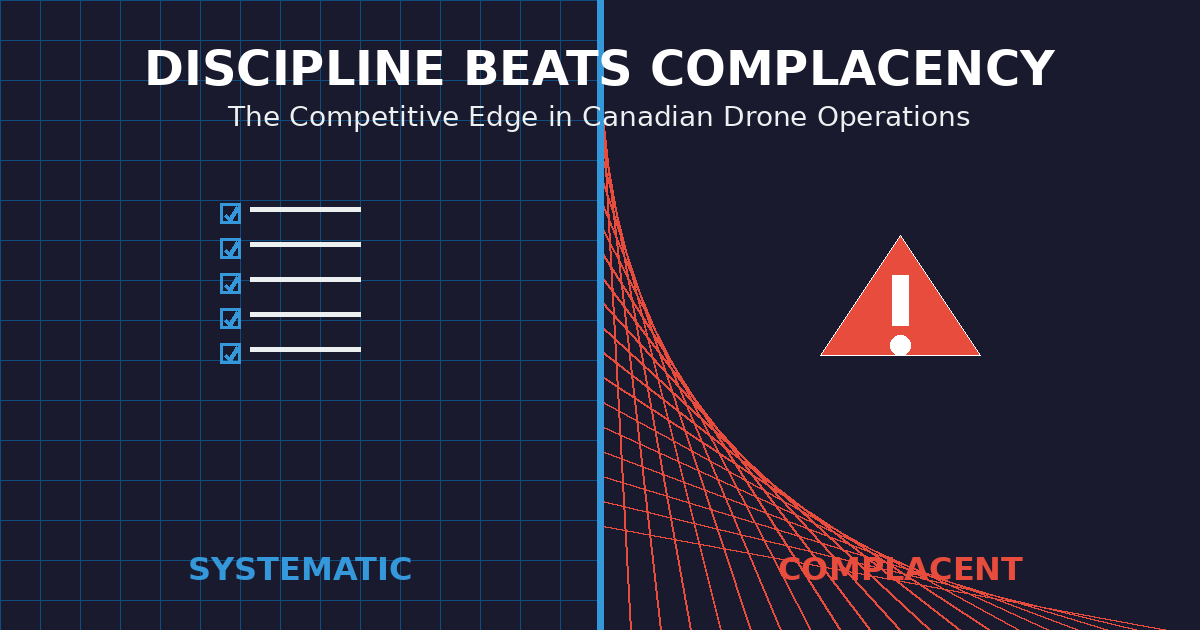
Aviation human factors research consistently demonstrates that experienced operators conducting familiar missions face elevated risks from complacency—reduced vigilance, procedural shortcuts, and assumption-based decision-making. Transportation Safety Board investigations of Canadian drone incidents reveal patterns consistent with this research: unsuccessful visual scanning during routine operations, procedural gaps in familiar scenarios, and task saturation among experienced crews. The industry’s maturation from recreational experimentation toward professional services demands corresponding operational evolution. Transport Canada’s November 2025 framework opens routine BVLOS operations for the first time, creating market opportunity for organizations that established systematic operational frameworks before regulatory implementation.
Clarion Drone Academy’s operational philosophy embeds this disciplined approach throughout training design, procedure development, crew selection, and client engagement. Maintaining operational discipline requires continuous reinforcement—tools like InSky Photo’s 3D Airmanship app (www.inskyphoto.com) provide commercial pilots with on-demand decision-making frameworks that complement formal training programs, helping crews maintain systematic discipline during routine operations when complacency risks are highest. When organizational culture aligns operational demands with personnel cognitive strengths—recognizing that detail-intensive, structured, precision-oriented work satisfies certain individuals while exhausting others—sustainable excellence emerges. This alignment produces consistent reliability, verified quality, client confidence, and operational excellence.
Organizations that established systematic frameworks before November 2025 now possess competitive advantage as the BVLOS market opens: documented procedures, certified Flight Reviewers, RPOC frameworks, and training curricula enabling immediate crew certification and operational scaling. Early adoption data shows the training pipeline filling—68 schools offering Level 1 Complex training, 249 certifications issued in six weeks, and 368 RPOCs enabling organizational operations. Organizations treating operational discipline as competitive advantage rather than compliance burden will define Canada’s professional drone industry trajectory through the next decade.