A Tale of Two Nations: America Expands Drone Infrastructure While Canada Lets Foremost Wither
By Bruce McPherson, CEO, Clarion Drone Academy Inc. | January 2026
On January 8, 2026, U.S. Transportation Secretary Sean Duffy announced two new FAA UAS Test Sites—the first expansion of America’s drone testing infrastructure in nearly a decade. The Choctaw Nation of Oklahoma and Indiana Economic Development Corporation join seven existing facilities, bringing America’s total to nine dedicated test sites for BVLOS operations, autonomous systems, and advanced air mobility.
Meanwhile, one of Canada’s only two approved BVLOS testing facilities sits idle, closed for lack of $200,000 in annual operating funds.
America Invests, Canada Divests
Secretary Duffy’s message was pointed: ‘It’s our job to make sure the United States safely leads the way with this exciting technology—not China.’ The announcement delivers on President Trump’s Executive Order ‘Unleashing American Drone Dominance’ and supports the Part 108 BVLOS rule with a February 2026 deadline. The Choctaw Nation already holds the largest BVLOS waiver in America at 377 square miles. Indiana brings military infrastructure and counter-UAS expertise. America is building infrastructure to match its regulatory ambition.
Canada took the opposite approach. The Foremost UAS Test Range in Alberta—2,400 square kilometres of Class F restricted airspace, nearly four times the size of Banff National Park—closed on September 30, 2025 when funding expired. Western Economic Diversification Canada invested $1.1 million since 2015. Alberta contributed over $750,000. This $1.85 million capital investment now sits idle because $200,000 in annual operating funds cannot be secured.
Regulatory Expansion Without Infrastructure
Canada’s November 4, 2025 regulatory updates introduced Level 1 Complex Operations certification, enabling lower-risk BVLOS flights without a Special Flight Operations Certificate. Medium drones up to 150 kilograms can now operate legally. Transport Canada spent years developing these regulations—yet the infrastructure required to validate systems under the new rules sits mothballed.
NAV Canada’s Alan Chapman called Foremost ‘the backbone for the testing capabilities that went into being able to develop the new regulations.’ The facility processes validation work for NAV Drone, which now handles over 1,000 flight authorization requests weekly. The Canadian drone market is projected to reach $9.9 billion by 2030, growing at 16 percent annually. Closing the infrastructure that enables this growth is policy incoherence.
What Canada Must Do
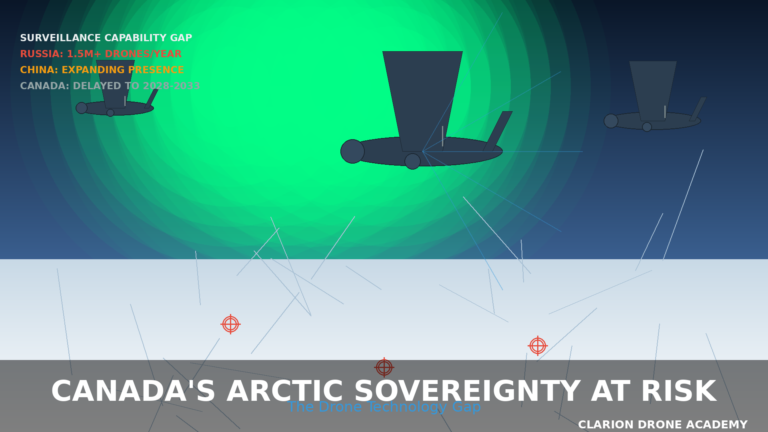
The federal government must treat this as a national security priority. Transport Canada, Innovation, Science and Economic Development Canada, and the Department of National Defence should establish emergency operating funding for Foremost immediately. The $200,000 annual requirement is trivial compared to the market opportunity and capital already invested. For context, Canada has committed nearly $22 billion in support to Ukraine, including over $150 million specifically for drone initiatives through the Drone Capability Coalition and Ukrainian domestic drone production. Drones have fundamentally transformed this conflict—from reconnaissance and artillery targeting to autonomous strike operations. Both sides deploy thousands of drones monthly, proving that uncrewed systems are no longer emerging technology but decisive battlefield capability. Yet Canada cannot find $200,000 to maintain domestic infrastructure for developing and testing these same systems. Drone testing infrastructure must be designated as critical national infrastructure under federal jurisdiction, recognizing these facilities’ role in defence capability, regulatory development, and economic competitiveness. America has explicitly framed drone dominance as a national security imperative—Canada must do the same.
The contrast between these January 2026 announcements tells a story of two nations making opposite choices. America invests in infrastructure to maintain leadership. Canada allows critical facilities to close while implementing regulations that require those facilities’ capabilities. The Foremost team spent eight years building regulatory relationships and airspace approvals that cannot simply be rebuilt later. Canada can lead in BVLOS drone operations or watch this market opportunity transfer to nations that prioritize innovation infrastructure. The choice is ours.