BRING THEM HOME
What it is: a Canadian-designed 406 MHz emergency locator beacon. In an emergency, it alerts search and rescue by satellite so people can be found and brought home.
Who it is for: aircrew, land forces, naval and search-and-rescue personnel working in remote and Arctic conditions.
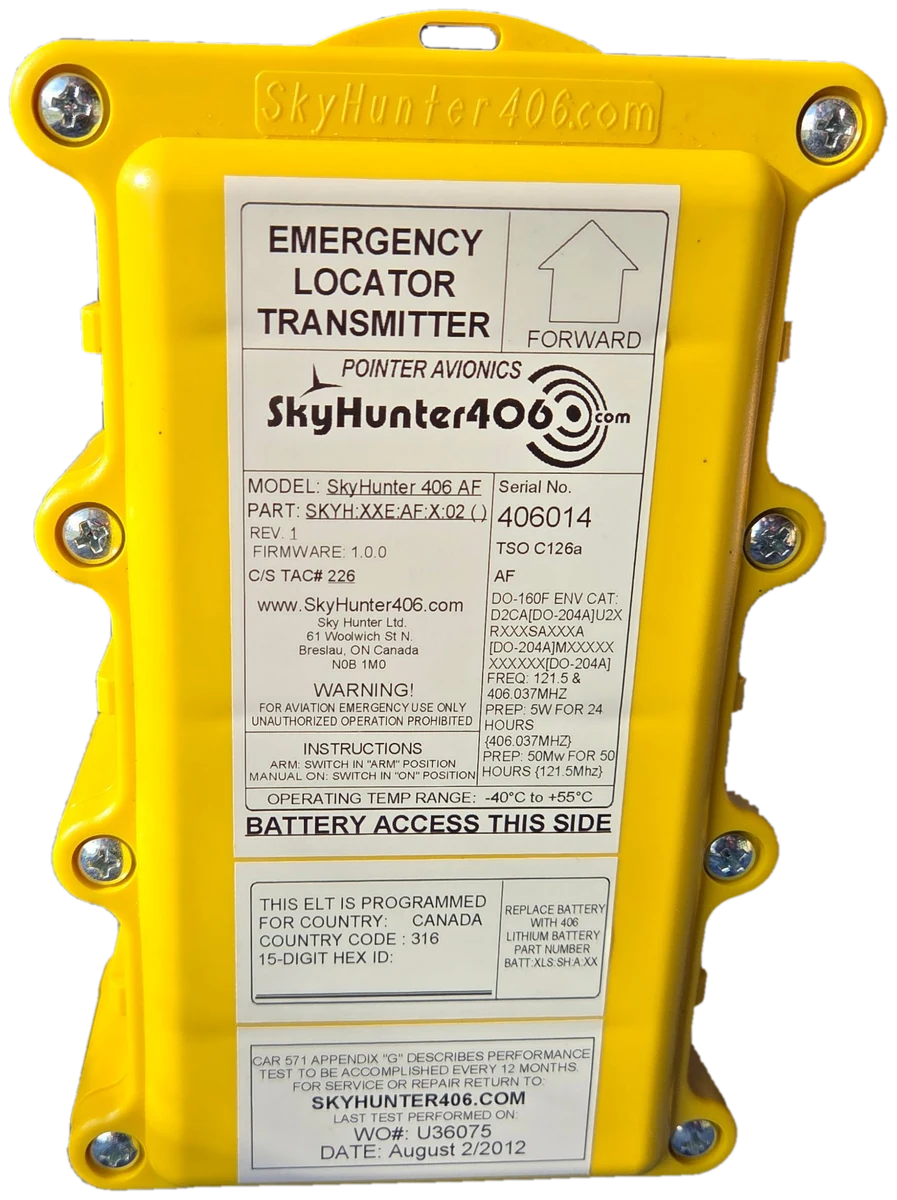
COSPAS-SARSAT TYPE APPROVED · CERTIFICATE NO. 226
Designed, certified and manufactured in Canada
Certification held and current: no multi-year approval barrier
Air · Land · Sea: one 406 MHz platform
Approved to −40 °C (tested to −55 °C): built for Arctic operations
FALSE ALARMS COST TIME AND MONEY.
Every alert has to be checked. Before anyone is sent, the Canadian Mission Control Centre (CMCC) and the Joint Rescue Coordination Centre (JRCC) must find out who owns the beacon and whether the aircraft is really in trouble.
A phone call or an aircraft launch. When the beacon’s origin is known, JRCCs close 97% of false 406 MHz alarms without a launch. When it isn’t, aircraft and crews go. 04
Most false alarms are avoidable. The number one cause of false ELT alerts is incorrect testing during maintenance. 01
The aircraft code must be right. Every ELT carries the aircraft’s 24-bit address so rescuers know which aircraft is down, and Transport Canada requires it to be checked every year. Most owners can’t check it without a shop and special test equipment. 05
Downtime adds up. When an ELT is removed, the aircraft must carry a cockpit placard, and the ELT must be back within 30 days for private aircraft or 10 days for commuter and airline operators. 06
THE LAST CANADIAN-OWNED BEACON MANUFACTURER.
Saves time
The yearly check is done on site. No removal, no placard, no downtime.
Saves money
Fewer false-alarm launches. Aircraft and crews stay ready for real emergencies.
Safer by design
Every service and battery change is logged. A full history for every beacon.
Canadian sovereign
Designed, certified and IP held in Canada. Cold-proven to −55 °C.
LOOKING FOR SKYHUNTER 406?
YOU ARE IN THE RIGHT PLACE.
The SkyHunter 406 was designed, certified and built by Bruce McPherson at SkyHunter 406 Ltd. Bruce is now Founder and CEO of Clarion Drone Academy Inc., a Canadian drone training and consulting company serving government, military and law enforcement.
That is why skyhunter406.com, the address on the beacon, now brings you here. All SkyHunter 406 enquiries come to Bruce directly.
- NOAA SARSAT, False Alerts and Outreach Analysis (2023 U.S. data, 2024): 98.4% of ELT activations were non-distress; testing is the leading cause of ELT false alerts.
- Department of National Defence search costs reported by CBC News, Search and rescue for false alarms costs millions (2014) and Atlantic search and rescue false alarms cost taxpayers millions (2014). Adjusted to August 2026 dollars with the Statistics Canada Consumer Price Index.
- Estimate. The U.S. 2023 false-ELT rate (about 58 per 1,000 ELTs) applied to about 25,800 Canadian aircraft required to carry an ELT, with the Canadian 406 MHz launch rate of about 3.3% (Canada Gazette, Part I, June 1, 2019), over a 12-year beacon life. Assumes the SkyHunter service system prevents 25–50% of false-alarm launches; to be validated with search-and-rescue partners.
- Department of National Defence, Evaluation of CAF Operations – Search and Rescue (2020).
- Transport Canada Airworthiness Manual 551.104 and Advisory Circular 571-025 (ELT operational test).
- Canadian Aviation Regulations, sections 605.38 and 605.39.
- Cospas-Sarsat beacon manufacturer contact list (October 2026).