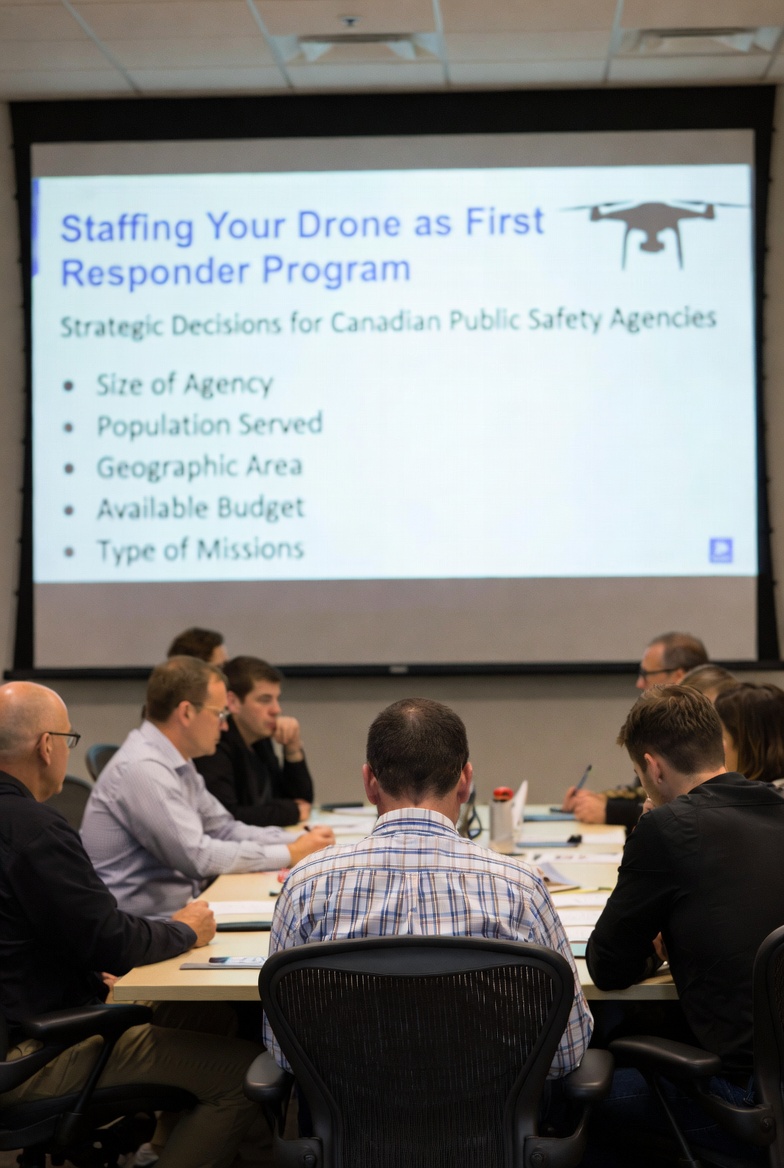
Staffing Your Drone as First Responder Program: Strategic Decisions for Canadian Public Safety Agencies
Canadian public safety agencies from Alberta RCMP to Peel Regional Police are adopting Drone as First Responder (DFR) programs, where drones launch immediately to 911 calls. The most common question isn’t about technology—it’s staffing: ‘How are we going to staff it?’ This article examines staffing strategies within Canada’s regulatory context, recognizing that DFR isn’t about adding positions—it’s about strategic resource allocation where speed defines the entire value proposition.
Understanding DFR Within Canada’s Regulatory Environment
Transport Canada’s November 4, 2025 regulatory changes introduced Level 1 Complex Operations certification, enabling lower-risk Beyond Visual Line of Sight (BVLOS) operations without requiring a Special Flight Operations Certificate (SFOC) for each mission. DFR pilots require Advanced Operations or Level 1 Complex certification (20 hours ground school, exam, flight review). Organizations need an RPAS Operator Certificate (RPOC) demonstrating appropriate policies and procedures.
Alberta RCMP’s pilot project in Lac La Biche, Red Deer, and Stoney Nakoda First Nation illustrated operational realities: Transport Canada regulations required a visual observer within 3.2 kilometres to monitor airspace. This impacts staffing—DFR operations often cannot be conducted with a single remote pilot alone. Level 1 Complex Operations must remain in uncontrolled airspace, below 122 metres, and five nautical miles from aerodromes, shaping where agencies position infrastructure and how they staff programs.
The Staffing Challenge: Priority Over People
Every Canadian agency already has personnel. The question isn’t whether people exist—it’s about determining which positions deliver the best return on investment. Most successful DFR programs don’t add new positions—they strategically reassign existing resources. This might mean utilizing injured-on-duty officers, engaging retired members, hiring civilian pilots at lower cost, or integrating DFR into Real Time Crime Centers. Peel Regional Police exemplifies this, managing DFR through their existing Aerial Support Unit and Community Safety Operations Centre rather than building entirely new units.
Agencies traditionally prioritize investigative and specialty units that rarely give resources back to patrol. DFR represents a paradigm shift: investing in front-end response that reduces back-end investigative burden. Early arrests from rapid DFR response save detectives weeks of work. Prevented escalations reduce officer-involved shooting investigations costing millions. This front-loaded efficiency fundamentally changes the resource equation.
Speed as DFR’s Core Value
Speed differentiates DFR from patrol-deployed drones. Traditional models keep drones in vehicle trunks until officers arrive on scene. DFR inverts this: the drone arrives first, often before calls enter CAD, providing situational awareness that shapes the entire response. The most successful programs share one element: dedicated pilots whose only focus is monitoring real-time alerts and launching immediately.
Alberta RCMP’s Constable Setlack demonstrated this, operating from a command centre 1.5 kilometres away, providing real-time intelligence on a homeless shelter incident before officers arrived. This capability—what can be called ‘response muscle’—develops only through dedicated focus. International programs consistently report 15%-40% call clearance rates through drone response alone. Toronto research on drone networks found six-minute reductions in urban AED delivery times and ten minutes in rural areas, demonstrating the speed advantage translating directly to DFR’s incident resolution capacity.
Staffing Models and Training
Canadian agencies don’t need 24/7 coverage to start. Begin with the busiest 8-10 hour block daily, focusing primarily on speed metrics: launch time, arrival time, comparison to ground units. Once pilots develop rapid-response capability, they generate unexpected successes that justify scaling. Staffing options include dedicated sworn officers (highest authority, highest cost), modified duty officers (maintains law enforcement knowledge while keeping injured members contributing), civilian pilots (lower cost, requires clear operational protocols), retired members (institutional knowledge, flexible hours), and integrated RTCC staff (leverages existing infrastructure).
Canadian DFR pilots require structured training beyond basic certification. Level 1 Complex Operations needs 20-hour ground school, advanced exam, and flight review. However, DFR demands additional specialized training: dispatch coordination, tactical assessment, evidence documentation, Transport Canada operational limits, emergency procedures, and privacy considerations. This investment is significant but essential—inadequately trained pilots undermine credibility and create legal exposure.
Canadian Context: Challenges and Considerations
Canada’s vast geography presents unique challenges and opportunities. Urban density creates controlled airspace complexity, while remote communities where response times measure in hours represent ideal DFR applications. Cold weather operations demand specialized equipment—battery performance, icing conditions, and operator dexterity all require consideration. First Nations communities, as demonstrated by Alberta RCMP’s Stoney Nakoda pilot, may particularly benefit given geographic isolation.
Privacy concerns significantly impact program acceptance. Hamilton’s drone use raised transparency questions. Kingston police faced Charter rights concerns over traffic enforcement. Successful programs require clear data policies, transparent deployment communication, explicit limitations on facial recognition, regular community consultation, and documented Charter compliance protocols. Peel police proactively addressed this, stating drones ‘will not be used for general surveillance or utilize facial recognition technology.’ Cost considerations favor DFR: helicopters cost $500-600 hourly while quality drones operate for minimal per-flight costs, though staffing expenses determine program sustainability.
Implementation Roadmap
Canadian agencies should implement DFR through a phased approach. Initial planning establishes the foundation: obtain RPOC certification, train and certify pilots through Level 1 Complex or Advanced Operations, conduct airspace analysis identifying controlled zones and optimal launch locations, integrate with CAD systems, develop privacy policies addressing community concerns, and secure initial equipment. This planning phase typically requires 2-3 months.
The pilot program phase proves operational viability. Deploy during peak call periods (8-10 hours daily, 5-6 days weekly) rather than attempting 24/7 coverage immediately. Measure success through concrete metrics: average launch time from call receipt, drone arrival time versus ground unit arrival, percentage of calls cleared without officer dispatch, tactical advantages documented through specific case examples, and officer feedback on situational awareness improvements. Run this phase for 4-6 months to generate meaningful data.
Evaluation determines program future. Analyze quantitative results—response times, clearance rates, cost per incident versus traditional response. Document qualitative benefits—officer safety enhancements, investigation efficiency gains, community perception improvements. Present findings to police boards or municipal councils with clear expansion recommendations based on demonstrated return on investment. Successful pilots consistently show that dedicated DFR pilots deliver force-multiplier effects justifying permanent program status.
Conclusion: The Strategic Choice
The question facing Canadian public safety leaders isn’t whether DFR works—Alberta RCMP, Peel Regional Police, and international agencies have already proven the concept. Transport Canada’s November 2025 regulatory framework removed barriers. Equipment technology is mature and affordable. The real question is strategic commitment: will agencies prioritize the pilot chair over competing resource demands?
Watch commanders at established DFR programs report the same finding: given a choice between adding another patrol officer or funding a dedicated DFR pilot, they choose the pilot. One skilled pilot monitoring real-time alerts influences multiple calls simultaneously, arriving before ground units, providing tactical intelligence that prevents escalation, clearing incidents without officer dispatch, and documenting evidence while events unfold. This force-multiplier effect transforms operational capacity.
For Canadian agencies evaluating DFR, the critical question isn’t ‘How will we staff this?’ but rather ‘Which existing position delivers less value than a dedicated DFR pilot during our busiest hours?’ The answer to that question—and leadership’s willingness to act on it—determines whether the agency views drones as peripheral technology or recognizes DFR as the strategic capability reshaping emergency response across North America. Speed defines DFR. Dedicated pilots deliver speed. Strategic staffing decisions enable both.
References
- Royal Canadian Mounted Police. (2024). Alberta RCMP expanding use of drones to respond to calls for service. Retrieved from https://rcmp.ca/en/gazette/alberta-rcmp-expanding-use-drones-respond-calls-service
- Peel Regional Police. (2025, August). Peel Regional Police exploring drone as first responder program. Statement to Global News and Now Toronto.
- Now Toronto. (2025, August 7). ‘Very cost effective,’ Peel police considering using drones as first responders for 911 calls. Retrieved from https://nowtoronto.com/news/very-cost-effective-peel-police-considering-using-drones-as-first-responders-for-911-calls-expert-thinks-its-a-smart-move
- Global News. (2025, August 7). Ontario police force may be 1st in Canada to use drones for some 911 calls. Retrieved from https://globalnews.ca/news/11321028/peel-regional-police-911-drones
- CBC News. (2025, August 11). Why Peel police think drone first responders could improve response times. Retrieved from https://www.cbc.ca/news/canada/toronto/peel-police-911-drones-1.7603270
- Mediaedge. (2025, April 28). Drones as a first responder: Improve response times, mitigating risks. Retrieved from https://mediaedge.ca/supplierinsights/oacp/drones-as-a-first-responder-improve-response-times-mitigating-risks