Transport Canada’s Blind Spot: Aviation Safety vs. Surveillance Oversight
When Kingston Police deployed a DJI Matrice 300 drone to catch distracted drivers in May 2025, they operated with full Transport Canada authorization. Their airspace permissions were in order, pilot certifications valid, and equipment compliant. Yet within days, the Canadian Constitution Foundation was threatening litigation, privacy commissioners were calling the operation absurd, and the Crown was withdrawing charges. The Kingston incident exposes a fundamental gap in Canada’s drone regulatory framework: Transport Canada has built a comprehensive system for aviation safety while leaving surveillance and privacy oversight almost entirely unaddressed.
What Transport Canada Regulates—and What It Does Not
Canada’s drone regulatory framework in Part IX of the Canadian Aviation Regulations represents one of the most developed systems globally. As of December 2025, Transport Canada reports 116,304 registered drones, 128,888 Basic Pilot Certificates, 20,138 Advanced Pilot Certificates, and 249 Level 1 Complex Pilot Certificates issued. The sector now includes 368 active RPAS Operator Certificates, 1,328 Flight Reviewers, and 269 self-declared Drone Flight Schools—68 of which are Level 1 Complex Training Providers. The November 2025 updates introduced Level 1 Complex certification for BVLOS operations, RPOC requirements, accountable executive mandates, and structured penalty frameworks.
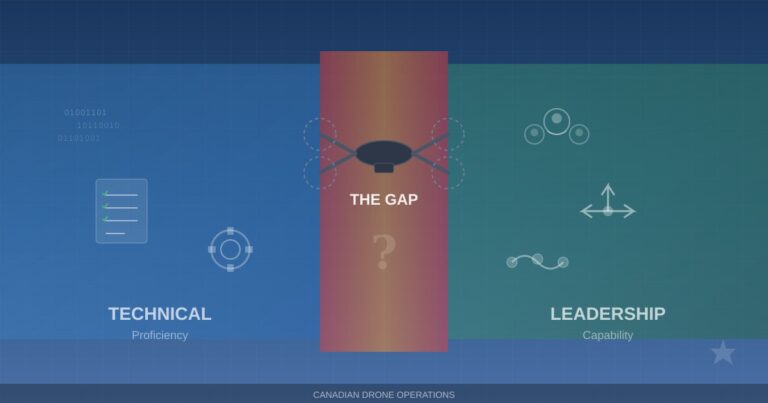
These regulations address aviation safety—preventing collisions, protecting people on the ground, ensuring pilot competency. What they do not address is what operators do with collected data. Whether a police drone should zoom in on citizens inside their vehicles falls entirely outside Transport Canada’s regulatory scope.
The Kingston Case: Compliance Without Authority
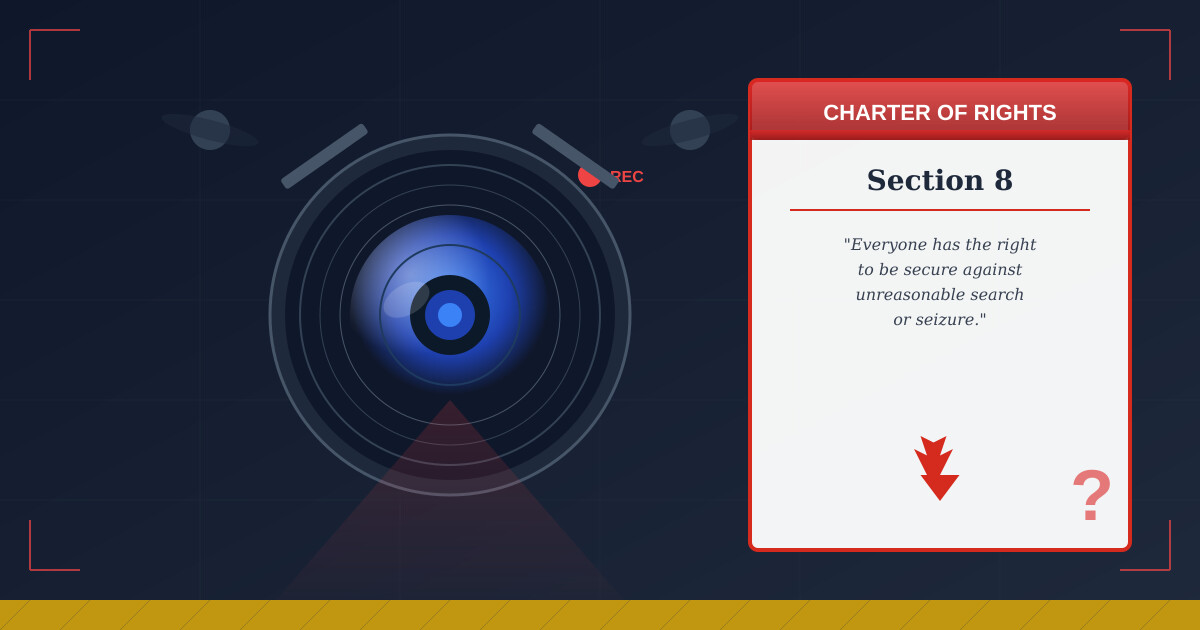
Kingston Police followed Transport Canada’s rules precisely. They obtained NAV Canada authorization and had used the drone since 2021 for collision reconstruction and missing persons searches. The distracted driving operation seemed a natural extension. The problem was not aviation compliance—it was constitutional authority. Section 8 of the Charter protects Canadians against unreasonable search and seizure. The Canadian Constitution Foundation argued that using zoom cameras to record drivers inside vehicles, capturing footage of hands and phone screens, constitutes warrantless surveillance the Charter prohibits. Former Ontario Privacy Commissioner Dr. Ann Cavoukian called the approach absurd, noting that close-range drone filming eliminates any reasonable expectation of privacy.
Chief Scott Fraser’s response revealed the institutional blind spot. He noted the department did not seek legal advice because they believed their evidence-gathering was indistinguishable from traditional methods. This assumption—that regulatory compliance equals legal authority—represents a dangerous gap that Transport Canada’s framework does nothing to address.
The Expanding Law Enforcement Drone Footprint
Kingston is not isolated. The RCMP’s RPAS Program now supports crime scene investigation, search and rescue, emergency response, and border security, with an RPAS corridor established along the Canada-U.S. border in 2024. Vancouver Police flew 1,826 drone missions in 2024. Alberta RCMP has piloted Drone as First Responder programs. Peel Regional Police is preparing to deploy drones for 911 responses. Each program operates under Transport Canada’s aviation framework. None operates under comprehensive surveillance oversight. The Information and Privacy Commissioner of Ontario commissioned research in 2024 examining drone surveillance capacities, acknowledging the urgent need for guidance that does not yet exist.
The Role of Drone Training Providers
Canadian drone schools have an opportunity—and arguably an obligation—to address this gap. While training providers cannot offer legal advice, they can equip students with the awareness, frameworks, and professional attitudes needed to navigate privacy considerations responsibly. Transport Canada’s curriculum focuses on airspace, weather, regulations, and flight safety. It does not address what happens after the camera starts recording. This is where professional training programs can differentiate themselves and better serve their clients.
Effective privacy-aware training should include foundational knowledge of Section 8 Charter principles and how courts have applied them to emerging surveillance technologies. Students should understand the difference between aviation compliance and legal authority to collect data. Case studies like Kingston illustrate this distinction vividly. Training should also cover practical policy development: how to create standard operating procedures that address what will be recorded, how long data will be retained, who can access it, and when it will be destroyed. Students should learn to conduct basic privacy impact assessments and recognize situations requiring legal consultation before deployment.
Perhaps most importantly, training providers can instill professional attitudes that go beyond minimum compliance. The question is not simply whether an operation is legal, but whether it is appropriate, proportionate, and defensible. Operators who develop this mindset will be better positioned to serve clients, avoid reputational damage, and contribute to public trust in the broader drone industry. With 269 drone flight schools now operating in Canada, those that integrate privacy awareness into their curricula will produce graduates better prepared for the realities of professional operations.
What Professional Operators Must Do Now
The regulatory gap will not close quickly. With over 116,000 registered drones and nearly 150,000 certified pilots operating in Canada, professional operators cannot wait for legislators or courts to establish clear boundaries. Transport Canada compliance is necessary but insufficient. The Canadian drone market—valued at over $4 billion USD in 2024 and projected to reach nearly $10 billion by 2030—cannot afford reputational damage from poorly planned surveillance operations. Kingston assumed that because they could legally fly the drone, they could legally use it for traffic surveillance. This cost them public trust, triggered litigation threats, and resulted in withdrawn charges. Those who wait for regulators to close the gap may find themselves on the wrong side of both public opinion and constitutional law.