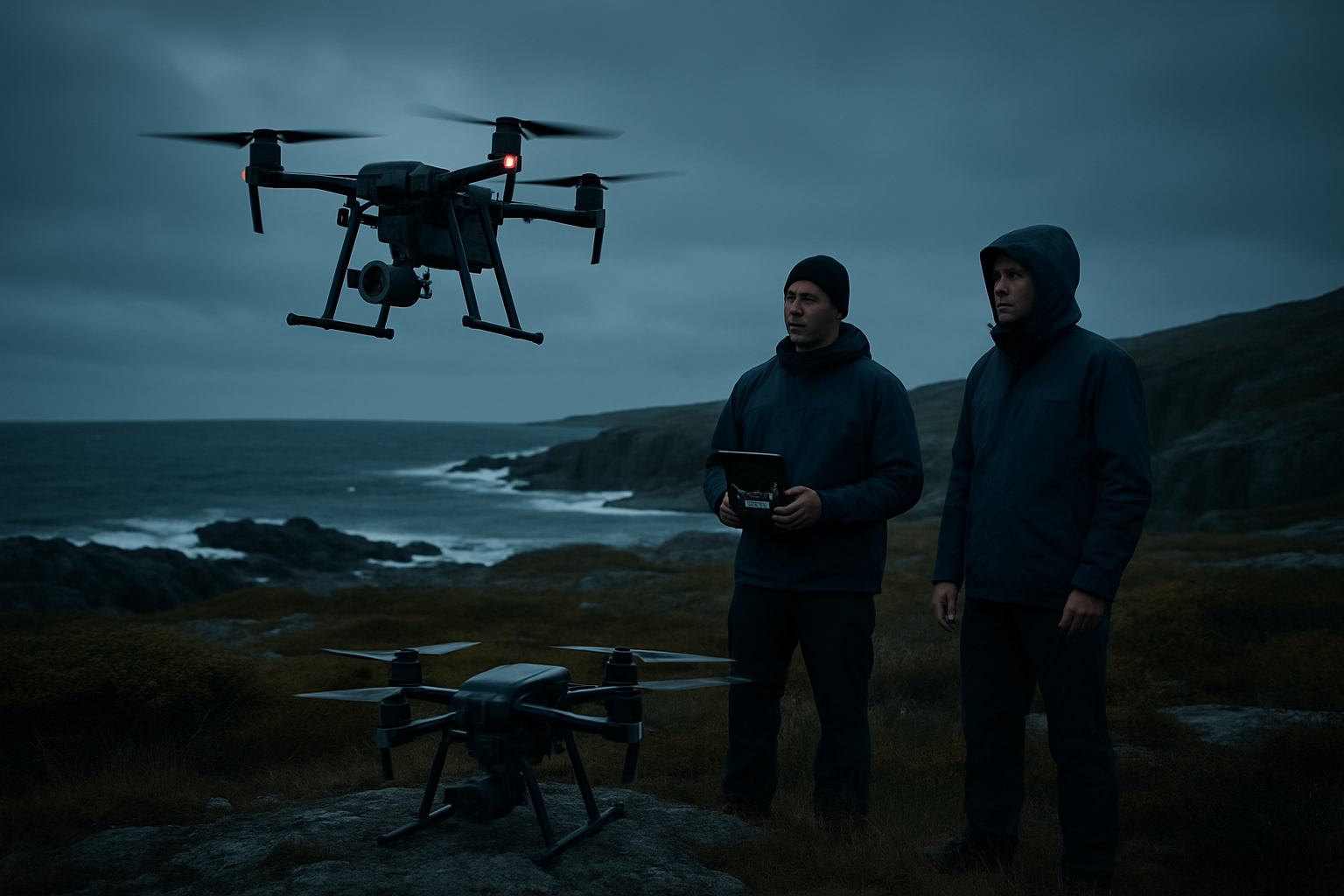
A Flight Reviewer Told Me Most Candidates Cannot Execute a Lost Link Procedure. That Should Alarm Everyone.
A flight reviewer recently told me that the majority of BVLOS candidates he evaluates can accurately describe a lost link procedure. They recite the steps correctly. Then he asks them to execute it — simulated pressure, VO calling in traffic, clock running — and most of them fail. This is not a knowledge problem. Ground school is doing its job. This is an execution problem, and the gap between knowing a procedure and performing it under operational stress is exactly where commercial drone operations become dangerous.
Ground School Cannot Close an Execution Gap
Transport Canada’s Advanced Operations exam is a knowledge assessment. It is designed to verify that a candidate understands Canadian airspace structure, RPAS regulations under CARs Part IX, and operational concepts including lost link procedures and contingency planning. It does this effectively. What it cannot do — and was never designed to do — is verify that a candidate can execute those procedures when things are moving fast and the pressure is real. That distinction matters enormously for commercial BVLOS operators. An RPOC applicant is building a safety case around documented procedures. Those procedures are only as reliable as the crew executing them. Transport Canada’s November 4, 2025 regulatory changes have expanded the pathways available for BVLOS authorization, which means more operators are moving toward complex operations at a faster pace. The training pipeline feeding those operations has not kept pace with the procedural demands now placed on crews. Ground school produces candidates who know what to do. It does not produce candidates who have done it.
The Institutional Gap Nobody Names Directly
The antagonist here is not Transport Canada’s exam design — it is the assumption embedded in most Canadian drone training programs that conceptual understanding transfers automatically into procedural competency. It does not. In Clarion’s experience training government and commercial clients for BVLOS operations, operators consistently underestimate the cognitive load of managing a lost link sequence while simultaneously maintaining Visual Observer communication discipline and monitoring a contingency volume boundary. These tasks require parallel processing under stress. That is a practiced skill, not a studied one. The flight review is frequently the first environment where candidates are asked to perform these tasks simultaneously and under time pressure. When the reviewer introduces a complicating variable — degraded communications, a VO report that conflicts with aircraft telemetry — candidates who have only ever processed these scenarios as theory have no practiced response to draw on. They hesitate. In a real operation, hesitation inside a lost link timeline is not a training note. It is a safety event.
What Procedural Readiness Actually Requires
Closing this gap requires deliberate scenario-based training that places candidates inside contingency procedures before the flight review does. Lost link execution, VO communication under degraded conditions, and contingency volume management need to be practiced as integrated tasks — not reviewed as separate checklist items. This means tabletop scenarios that introduce competing inputs. It means timed drills where the correct action has to be retrieved under cognitive load. It means debriefing not on whether the candidate knew the right answer, but on whether they executed the right sequence in the right order without prompting. For operators pursuing RPOC authorization, this level of crew preparation is not optional — it is the foundation of a credible safety case. Transport Canada’s RPOC framework expects operators to demonstrate that their procedures are operationally sound. A crew that freezes on a simulated lost link does not support that claim. Clarion builds this execution layer into advanced BVLOS preparation specifically because the knowledge-to-performance gap is real, it is consistent, and it shows up at the worst possible moment.
The Question Operators Need to Answer Before the Reviewer Does
The November 2025 regulatory changes have made BVLOS authorization more accessible for qualified Canadian operators. That is a genuine opportunity. It also means more crews are moving into complex operational environments faster than their procedural muscle memory has been built. Before your team sits down with a flight reviewer — or before your next RPOC renewal cycle — ask one question: when did your crew last execute a lost link procedure under pressure, with competing inputs, without prompting? If you cannot name a specific training event, your safety case has a gap that your ground school transcripts cannot close. The reviewer will find it. The more important question is whether you find it first.
Continue the Conversation
The Clarion Professional Network has an active thread on BVLOS crew evaluation — specifically what flight reviewers are flagging as the most consistent procedural failures they’re seeing in 2025. If you’re preparing crews for RPOC operations or advanced flight reviews, that conversation is worth reading before your next evaluation cycle.