A Security Approval Is Not a Flight Test: What a DHS Blue UAS Evaluation Means for Ontario’s Drone Replacement
In September 2026, DroneXL reported that DHS put six Blue UAS in front of 26 public safety pilots across three rounds of testing. Three of the five aircraft brought to Hudson Yards in Manhattan were excluded from scoring there because they could not hold position without drifting. According to DroneXL, the report states that a Blue List designation says nothing about whether an aircraft can do the job public safety needs done. Ontario has said work is underway to replace Chinese-made government drones with aircraft from Canada and “other approved jurisdictions.” That is a sourcing rule. The question this article puts on the table is whether a sourcing rule is the same thing as a performance standard.
What the DHS Evaluation Actually Tested
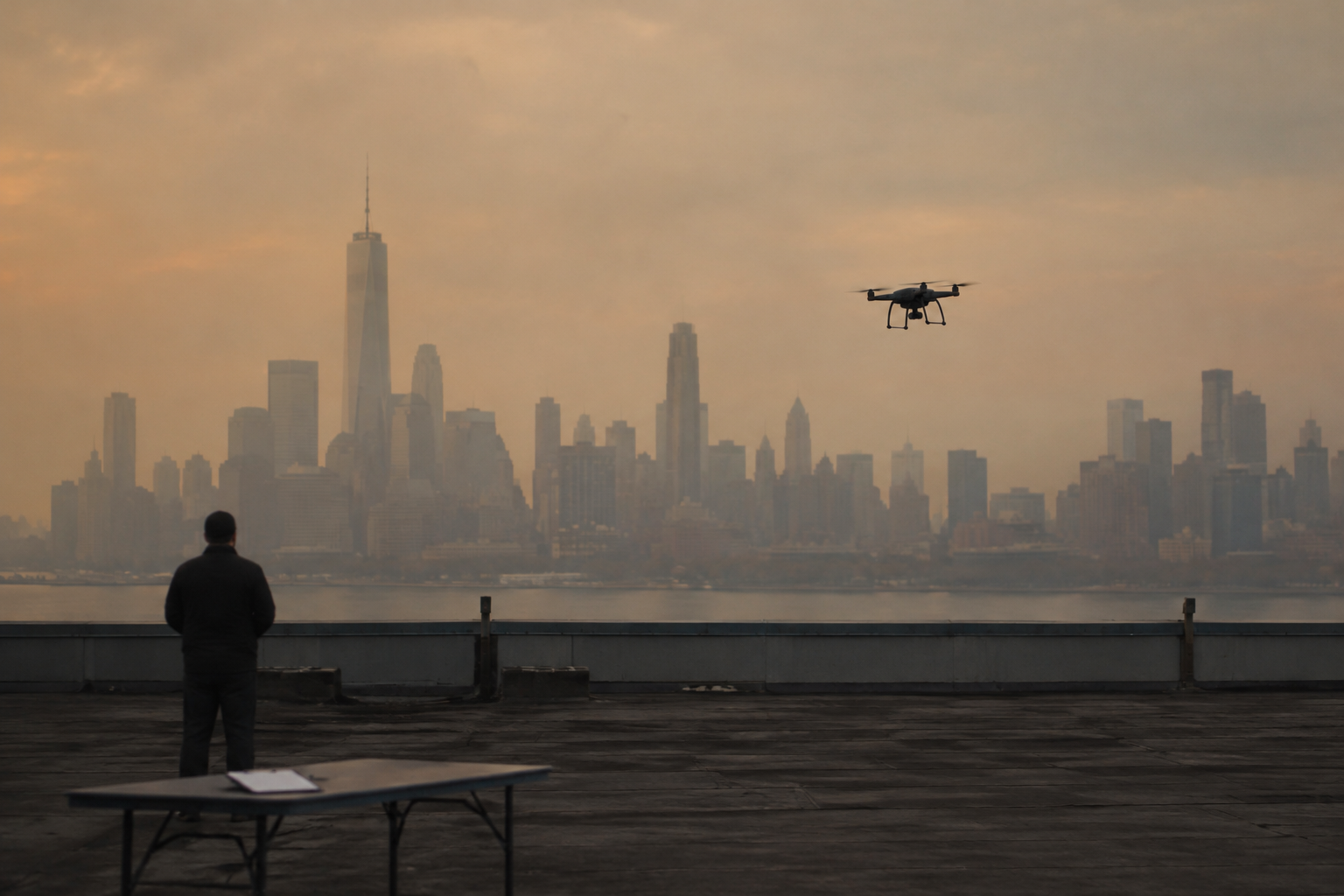
The DHS assessment ran from June 2024 in rural Texas, moved to Miami that November, and ended at Hudson Yards in Manhattan in July 2025. The evaluators came from 13 states and included pilots from the NYPD, FDNY, Boston Fire, Los Angeles Police, Michigan State Police, Texas DPS, the Coast Guard, and Customs and Border Protection. The DHS SAVER program page states that Blue UAS have been vetted to be compliant with DoD policy, and that the Blue List publication by the Department of Defense may aid responder agencies with their acquisition processes. DroneXL reported that the DHS assessment examined operator experience only and did not evaluate national security risk under any statute.
DroneXL reported that only the Parrot ANAFI USA GOV and the Skydio X10D were rated at Hudson Yards. The Ascent AeroSystems Spirit lacked enough satellite reception to hold position. The Freefly Astro would not enter position mode and drifted constantly; a safety pilot tried switching it into position hold at a higher altitude, which did not work. The Teal 2 could not be launched safely without a GPS lock — a problem evaluators hit during familiarization flights at Fort Totten in Queens before they ever reached Hudson Yards. The Parrot ANAFI USA GOV lost its connection as close as 50 feet from the launch point, and one loss of link ended in a flyaway; its command and control link scored 1.8 out of 5 in the complex urban round.
The Skydio X10D, also on the Blue UAS list, received the best rating of the six systems: 4.0 in Miami and 3.7 at Hudson Yards. That result cuts both ways. Being on the Blue List told evaluators nothing in advance about which aircraft would hold position and which would not.
One more boundary on these findings: the test data is between 16 and 29 months old. Hardware and software change. DroneXL also reported that DHS flew Chinese-made drones alongside the Blue UAS at Hudson Yards, that those results are not in the public report, and that the executive summary says evaluators found large differences in capability between the two groups without saying which way the differences ran. DroneXL later reported that it obtained an addendum numbered SAVER-T-R-40 and dated July 2026. According to DroneXL, the addendum scored the DJI Matrice 4T at 4.6 out of 5 and the DJI Matrice 30T at 4.3 at Hudson Yards, against 3.7 for the Skydio X10D and 2.4 for the Parrot ANAFI USA GOV. The public report says results for those platforms are available to public safety agencies upon request.
What Ontario’s Policy Actually Says
Ontario’s May 20, 2026 announcement states that work is underway to phase out broader government use of Chinese-made drones and replace them with those manufactured in Canada and other approved jurisdictions, consistent with the provincial Buy Ontario policy, while ensuring critical frontline operations continue without interruption. The province currently uses drones for law enforcement, emergency management, wildfire monitoring, road and bridge inspections, and environmental monitoring.
Ontario’s May 2026 release stated it would consult and engage with industry and public sector stakeholders to identify a wide range of replacement options, including Canadian and Ontario drone manufacturers. That consultation could address performance. What we found no evidence of, after three searches, is a published Ontario standard for testing candidate aircraft in the conditions where its agencies actually fly. On May 21, 2026, NetNewsLedger reported that Ontario had not released a final approved replacement list.
The announcement included no cost estimate, no replacement inventory, and no procurement timeline. At committee on October 5, 2026, the Solicitor General said the government wants to explore restricting future government purchases of Chinese-made drones and that this will not impact public safety today. Bill 119, the Protecting Ontario’s Streets and Communities Act, 2026, was introduced May 25, 2026, reached Third Reading, and as of November 5, 2026 had not received Royal Assent. The bill does not put the drone restrictions into law; the October 5, 2026 committee transcript records the line: “There’s no specific restrictions in this bill on Chinese drones.”
A Sourcing Rule Without a Performance Floor
The DHS evaluation is a U.S. exercise built around a U.S. list. We found no Transport Canada or Canadian federal government approved-jurisdictions list for drone procurement analogous to the Blue UAS list. The question for Ontario is whether its “approved jurisdictions” category, like a Blue List designation, says anything about whether an aircraft can do the job public safety needs done.
DroneXL reported that DHS lists four top-level takeaways from the evaluation: GPS cannot be relied on in dense cities, the link between controller and aircraft is inconsistent, deployment takes too long, and cost is a barrier for many departments. The systems as tested cost between US$13,964 and US$56,195. DroneXL reported that the report’s summary states deployment time was unacceptable for most first responders, and that DHS adds if a drone takes too long to deploy or costs too much, responders may go back to traditional methods. After the report’s release, the Drone Service Providers Alliance went outside its own charter to ask every drone pilot and first responder in the country to call Congress about it. DroneXL’s coverage of that call quotes the line “a cybersecurity or procurement designation is not a substitute for operational capability.”
Ontario uses drones for wildfire monitoring, emergency management, road and bridge inspections, and environmental monitoring. Results from one dense Manhattan site do not predict how any aircraft would perform in those conditions; what they show is that a compliance list did not predict performance at that site. Ontario’s consultation with public-sector users was announced in May 2026; we found no published performance standard that resulted from it. Before a Canadian agency replaces its fleet, who flies the candidate aircraft in the conditions where it will actually work?
Continue the Conversation
In the Clarion Professional Network, practitioners working in public safety, government, and law enforcement are already debating what a performance standard for fleet replacement should actually look like. If you are navigating procurement decisions for your agency or program, that is exactly the conversation happening there — come join it.